
Better Insights. Better Actions. Better Impact.
We work with financial institutions to improve performance by helping them better understand and influence customer behaviour.
Behind every financial decision is a human decision. As behavioural experts, we identify the influences shaping how customers think, feel, make decisions and act, and apply those insights into the design of products, services, and behaviour change strategies.
The result is better impact: for customers and for the organisation.
Welcome
I’m Wayne Bateman, Founder of The Behavioural Economists: a global network of behaviour change experts who deliver significant and sustained impact for financial institutions. We operate from two independently registered companies - The Behavioural Economists in the UK and The Behavioural Economists Africa in South Africa - serving clients worldwide.
For almost 20 years, I’ve worked across the private, public, and charitable sectors to address complex behavioural challenges, applying behavioural science to real-world decisions, systems, and environments. My work is grounded in strong academic training, including a First Class Honours degree in Social and Psychological Sciences from the University of Cambridge and a Master’s degree in Evidence-Based Behaviour Change from the University of Oxford.
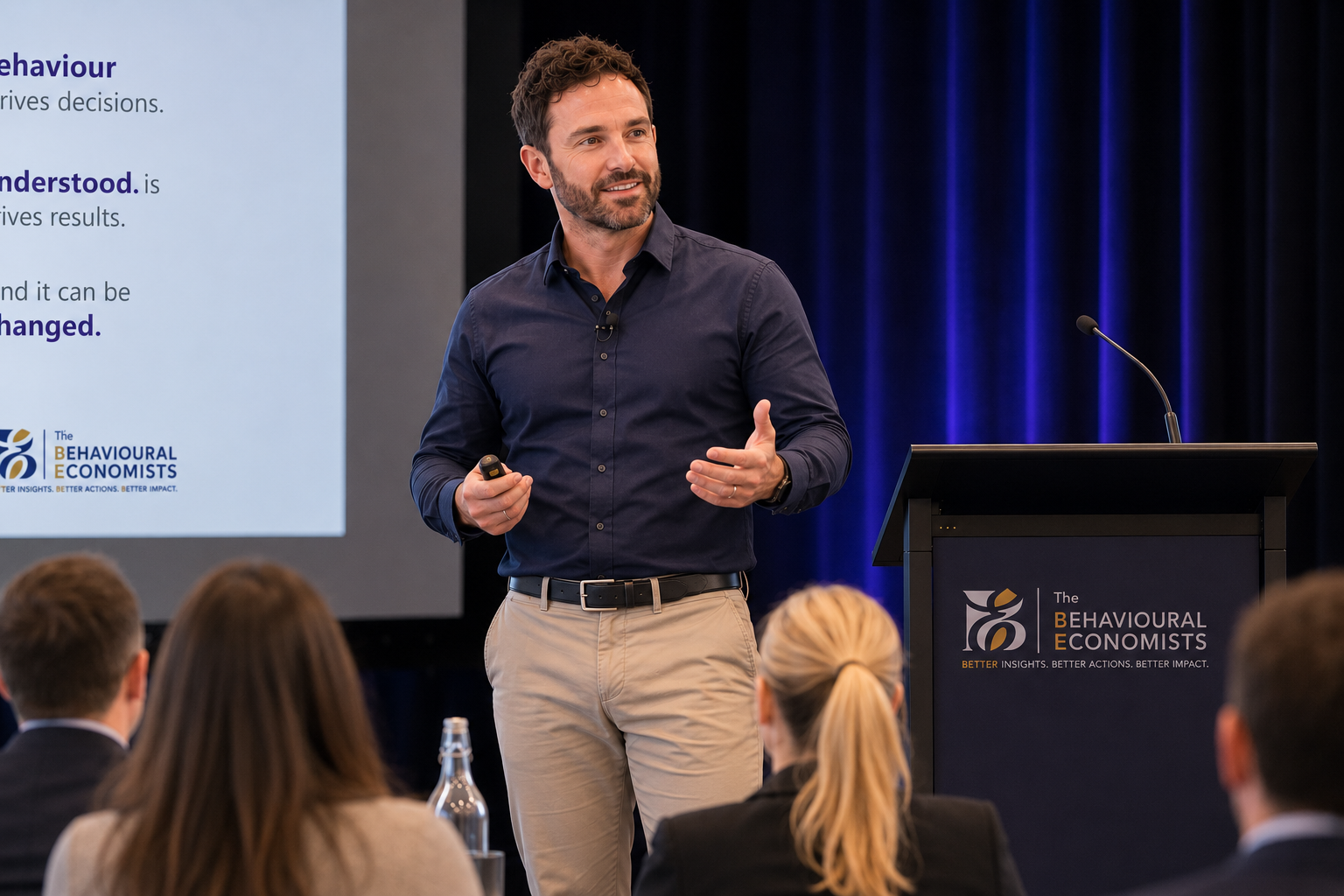
Since 2022, I have focused my work within financial services, partnering with leading global banks to build better products, services, and customer experiences using behavioural economics. I also design and deliver evidence-based training and coaching in behavioural science and behaviour change, ranging from short courses to comprehensive mastery programmes. I am currently the lead behavioural economics trainer and coach for Africa's largest bank. With a professional background in learning and development, including senior capability-building roles within the UK Government, I bring a depth of instructional expertise and behavioural science knowledge that is rare in the field.
What we do

Consultancy
We uncover the behavioural barriers and drivers behind key outcomes, then design and test practical interventions that create sustainable change. From credit card uptake to loan repayments to digital adoption. We use globally recognised methodologies to diagnose, design, test, and scale solutions.

Capability
We build internal behavioural economics expertise through practical training and coaching. From short workshops to our comprehensive year-long Behavioural Economics Practitioner Programme (BEPP). Your teams learn to identify barriers, design solutions, and embed behavioural thinking into everyday work.

Capacity
We provide dedicated behavioural expertise to integrate with and support your team, so that you can deliver more projects, more consistently, without the expense and commitment of long-term hires. The ideal solution for those with behavioural ambitions, but not enough capacity to progress them.
Where we have delivered impact
Credit Cards

-
Target: A major retail bank identified a persistent gap between its credit card product reach and the proportion of eligible customers actively holding and using a card. Three discrete target behaviours were scoped: (1) completing a credit card application; (2) activating an approved card within 30 days of receipt; and (3) making at least four card transactions per month within the first 90 days — the threshold above which cardholders show durable, habitual use.
-
Explore: Diagnostic interviews and think-aloud usability sessions were conducted with 240 approved-but-inactive cardholders to map where intent collapsed across the customer journey. Funnel analysis of 15,000 application sessions identified that 39% of drop-offs occurred at the credit check step — not from ineligibility, but from uncertainty about the outcome. Mental accounting research revealed that customers categorised credit cards separately from their debit accounts and lacked a psychological trigger to integrate the new card into their existing payment habits.
-
Solution: Eligibility pre-screening with social proof: A soft-check pre-qualification tool was introduced, allowing customers to see their likelihood of approval before formally applying. Messaging incorporated social norms framing — reducing loss aversion by transforming the application into a low-risk action grounded in the experiences of similar customers. Time-limited activation nudge: Drawing on present bias and implementation intentions, a sequenced SMS and in-app nudge was deployed within 48 hours of card approval, prompting customers to nominate a specific first-use occasion. An expiring introductory offer created temporal urgency to prompt action without manipulative pressure. Progress-based rewards to anchor habit: A visible spending tracker within the app leveraged the goal-gradient effect — showing progress toward a first reward threshold increased weekly transaction frequency by creating an identifiable finish line and reducing psychological distance to the next action.
-
Trial: A randomised controlled trial was conducted across a sample of 18,000 newly eligible customers, divided across control and three treatment arms corresponding to the pre-qualification, activation nudge, and habit tracker interventions respectively. Primary outcome measures were application completion rate, 30-day activation rate, and 90-day transaction frequency. Secondary outcomes included 6-month churn rate and average monthly spend. Trial duration was 12 weeks, with a pre-specified analysis plan agreed prior to launch to ensure evaluation integrity.
- Scale: Application completion rates increased by 34% following introduction of the pre-qualification tool, with the largest gains among customers who had previously abandoned the process at the credit check stage. Card activation within 30 days of approval rose from 41% to 67%, attributable primarily to the implementation intention nudge delivered in the post-approval window. Average monthly transaction frequency among new cardholders increased by 2.1 transactions per customer within the first 90 days, with sustained use confirmed at 6-month follow-up — indicating durable habit formation rather than incentive-driven activity. All three interventions were recommended for full rollout, with the pre-qualification tool prioritised for integration into the main digital acquisition journey.
Savings & Investments

-
Target: A leading financial institution sought to address a persistent gap between customers' stated savings intentions and their actual saving behaviour. Three target behaviours were defined: (1) opting into or being enrolled in a savings product; (2) maintaining consistent monthly contributions without early withdrawal; and (3) progressing from cash savings to investment products among eligible customers.
-
Explore: A longitudinal intention–behaviour gap study involving 600 customers confirmed that 74% intended to save regularly, while only 29% had made a consistent monthly deposit in the same period. Qualitative depth interviews identified three dominant barriers: present bias (the tendency to overweight immediate spending relative to future benefit), complexity aversion toward investment products, and the absence of concrete savings goals — making the future benefit too abstract to compete with present consumption. User journey mapping of the savings account opening process revealed that customers were rarely prompted to set a savings goal at the point of account creation, and that the default product journey positioned saving as an active choice rather than the expected behaviour — structurally reinforcing the intention–action gap.
-
Solution: Goal visualisation and future-self anchoring: At the point of account opening, customers were prompted to name their savings account after its intended purpose and to view a projected future balance based on a default monthly contribution. Naming accounts after goals has been shown to reduce premature withdrawals; the balance projection addressed present bias by making the long-term benefit concrete. Auto-enrolment with active choice: The default for eligible customers was redesigned from opt-in to automatic enrolment in a round-up savings feature, with a clear and accessible opt-out. This harnessed status quo bias in favour of saving rather than against it, while preserving genuine customer agency. Simplified investment pathway: Investment products were reframed using loss-aversion-aligned messaging highlighting the real cost of holding savings in cash during inflationary periods. The product selection journey was reduced to three steps using a guided matching tool, directly addressing complexity aversion and reducing decision fatigue. Each intervention underwent two rounds of user testing before trial.
-
Trial: Separate RCTs were run for each intervention. The auto-enrolment trial covered 22,000 eligible customers with a pre-specified primary outcome of active participation rate at 60 days. The investment pathway trial targeted 9,000 eligible non-investors, with product uptake within six months as the primary outcome. Goal-naming was evaluated as part of the savings account opening journey across 11,000 new accounts, with early withdrawal rate as the primary outcome measure.
- Scale: Auto-enrolment achieved an opt-out rate of only 18%, compared to a prior opt-in rate of 23% — a net increase in active savers of 59 percentage points among the eligible population. Named goal accounts showed a 43% reduction in early withdrawal rates compared to unnamed accounts, consistent with research on psychological ownership and commitment devices. Investment product uptake among eligible non-investors increased by 27% within six months of deploying the simplified pathway and reframed messaging, with the majority of new investors selecting medium-risk balanced funds — suggesting deliberate rather than impulsive decision-making. All three interventions were approved for full rollout.
Personal & Business Loans

-
Target: A challenger bank sought to improve outcomes across its loan products on three dimensions: (1) increasing application completion rates among customers who had initiated but not submitted an application; (2) increasing direct debit setup at the point of application; and (3) reducing first-payment failures within 90 days of drawdown — a strong predictor of longer-term default risk.
-
Explore: Funnel dropout analysis across 12,000 digital loan application sessions found that 44% of applicants abandoned the process at the affordability self-declaration stage — not because of ineligibility, but because the perceived effort of completing financial disclosures triggered avoidance behaviour. The section was presented as a single, undivided form, creating a high cognitive load at a moment of naturally elevated anxiety. Repayment pattern analysis combined transaction data with customer segmentation to identify that first-payment failures were disproportionately concentrated among customers who had not set up a direct debit during application. Qualitative research with this cohort found that repayment obligations felt abstract at the point of application — a temporal disconnect between borrowing and the future repayment responsibility.
-
Solution: Chunking and progress visibility: The affordability assessment was restructured from a single long-form page into a staged micro-task format with a visible progress bar. Drawing on task completion psychology and the Zeigarnik effect, breaking the form into five distinct steps reduced perceived effort and created forward momentum — lowering the cognitive cost of continuation. Repayment commitment device at application: All applicants were presented with direct debit setup as the default final step of the application journey, framed around protecting their credit record. Customers who declined were shown a single re-prompt displaying a concrete first repayment date, anchoring the future obligation. Social proof for business applicants: Business loan landing pages incorporated industry-specific approval statistics and peer testimonials, leveraging social proof and reference group identity to reduce perceived risk and increase application confidence among sole traders and SME owners.
-
Trial: A 16-week RCT was conducted across the personal loan application journey, with 14,000 new applicants randomised between the control (existing form design) and two treatment arms: chunked form only, and chunked form plus direct debit default. Business loan interventions were evaluated via a separate A/B test of the landing page across 6,000 visitors over eight weeks. Primary outcomes were form completion rate, direct debit setup rate, and 90-day first-payment failure rate.
- Scale: Affordability section completion rates increased by 38% following introduction of the chunked form design, with no change to the information required from applicants. Direct debit setup at application rose from 52% to 81%, and first-payment failure rates fell by 29% among customers enrolled during the pilot period. Business loan applications increased by 22% in the six months following deployment of social proof messaging, with no increase in credit risk as measured by 90-day delinquency rates — suggesting that volume growth was driven by previously reluctant but creditworthy applicants. All interventions were recommended for full rollout and integration into the core product journey.
Insurance Products

-
Target: A bancassurance provider identified declining performance across three measurable points in the insurance customer lifecycle: (1) product attachment at the point of current account opening; (2) policy renewal conversion among customers whose cover was lapsing; and (3) mid-policy engagement — a leading indicator of renewal intent and a predictor of churn.
-
Explore: Mental model research with 180 customers revealed that insurance was categorised as a 'grudge purchase' — customers acknowledged its rational necessity but derived no positive value from holding a policy, making it psychologically easy to deprioritise or cancel. Exit survey analysis found that 61% of non-renewing customers had made no claim in the prior policy period and perceived their premium as money wasted — a textbook outcome bias effect. Journey mapping confirmed that customers had no meaningful interaction with the insurer between purchase and renewal — a structural absence of perceived value that made cancellation the path of least resistance. Behavioural barriers were identified as primarily motivational: low salience of the protected risk, absence of a positive ongoing relationship, and outcome bias overriding actuarial reasoning.
-
Solution: Vivid loss framing at point of sale: Product descriptions were rewritten to lead with concrete, scenario-based loss narratives rather than feature lists. Drawing on availability heuristic research, making the insured risk cognitively accessible increased the perceived necessity of cover and reduced the grudge framing at the point of sale. Annual value statements: A mid-year 'your cover in action' communication was introduced, highlighting the aggregate value of protection held, claims paid to similar customers, and any assistance services used — transforming a dormant product into an active relationship. This directly addressed outcome bias by demonstrating value beyond the customer's personal claims experience. Auto-renewal with transparent opt-out: Renewal defaults were switched to auto-renewal with a clear, accessible opt-out window and a personalised renewal comparison. This reduced friction while preserving customer control — consistent with responsible application of default effects.
-
Trial: Three separate trials were run: a point-of-sale messaging test across 8,000 account openings; an annual value statement trial across 15,000 existing policyholders in the mid-policy window; and an auto-renewal default test across 20,000 policies approaching expiry. Each trial included a matched control group receiving existing communications. Primary outcomes were attachment rate, mid-period engagement rate, and renewal rate respectively.
- Scale: Insurance attachment rates at current account opening increased by 19% following the introduction of scenario-based loss framing. Mid-year annual value statements were associated with a 31% improvement in renewal rates among recipients compared to a matched control group. Auto-renewal combined with transparent opt-out communications increased overall policy renewal by 24 percentage points, with opt-out rates remaining low at 11%. Results across all three trials supported full rollout. The annual value statement was prioritised for integration into the ongoing customer communications calendar, given its compounding effect on renewal rates and its low marginal delivery cost.
Home Bonds

-
Target: A high street lender identified two distinct behavioural challenges within its mortgage business. For first-time buyers: (1) progressing from Agreement in Principle to full application within 14 days — the window within which intent is most likely to convert. For existing mortgage holders: (2) proactively switching or renewing a product within six months of their fixed-rate end date, rather than reverting to the standard variable rate.
-
Explore: Emotional journey mapping with 90 first-time buyer prospects identified anxiety peaks at three distinct moments: first contact with an advisor, receipt of the Agreement in Principle, and the product selection stage. At each of these moments, perceived risk was highest and support was lowest — a structural mismatch between customer need and service design. Cognitive load assessment of the product comparison journey found that presenting multiple mortgage products simultaneously, with varying rates, terms, and fee structures, triggered choice overload. Customers defaulted either to selecting the product with the lowest headline rate — ignoring total cost of credit — or abandoned the process entirely. For existing holders, data analysis confirmed that only 39% of customers within six months of their fixed-rate expiry had taken any action, with inertia and uncertainty about switching costs identified as the primary barriers.
-
Solution: Guided decision pathway with reduced choice architecture: The product selection journey was restructured using progressive disclosure — customers answered three preference questions and were presented with a maximum of two recommended products. This directly addressed choice overload while preserving genuine product choice and regulatory compliance. Normalisation messaging for first-time buyers: Anxiety at key decision points was addressed through social proof and normalisation, combined with explicit permission to ask questions — reducing the social inhibition that prevented customers from seeking the clarification needed to proceed. Switching prompt for existing holders: Mortgage holders within six months of their fixed-rate end date received a personalised rate review prompt using anchoring to illustrate the cost of reverting to the standard variable rate. An implementation intention prompt — asking customers to book a specific review call — converted passive awareness into scheduled action.
-
Trial: The first-time buyer interventions were evaluated via a 12-week RCT across 10,000 customers who had received an Agreement in Principle, randomised between the control (standard follow-up) and two treatment arms: normalisation messaging alone, and normalisation messaging combined with the guided product pathway. The switching prompt was evaluated via a separate RCT across 16,000 existing mortgage holders approaching their rate end date.
- Scale: First-time buyer application completion rates increased by 41% following introduction of the guided decision pathway. Customers who received normalisation messaging at the Agreement in Principle stage were 2.3 times more likely to proceed to full application within 14 days compared to the control group. Proactive rate review outreach to existing holders achieved a product switch or retention rate of 68%, significantly above the prior reactive renewal rate of 39%. All interventions were recommended for full rollout. The guided decision pathway was prioritised for integration into the main digital mortgage journey, and the switching prompt programme was extended to cover all mortgage holders on fixed-rate products.
Digital Adoption & Utilisation

-
Target: A mid-tier bank with a mature digital offering identified two distinct behavioural gaps. For branch-dependent customers: (1) completing at least one self-service digital transaction per month — the minimum threshold for sustainable channel migration. For existing app users: (2) engaging with at least one feature beyond basic balance checking within 60 days — a predictor of long-term digital engagement and cross-sell propensity.
-
Explore: Customer segmentation across 8,000 customers identified three distinct profiles: habitual branch users (for whom human contact was a fundamental expectation), cautious digital adopters (who had trialled the app but lacked confidence in its reliability for important transactions), and passive digital users (who had adopted the app but defaulted to a narrow set of familiar features). Usability and trust research with cautious adopters revealed that hesitation was not primarily driven by digital literacy, but by low perceived reversibility — customers feared making a mistake they could not correct without contacting someone. For passive users, feature non-engagement was attributed to low discovery: the app's secondary features were present but not contextually surfaced at moments when they would be relevant.
-
Solution: Visible undo and confirmation mechanics: For cautious adopters, key transaction journeys were redesigned to include explicit confirmation steps and a visible cancellation window for non-time-critical actions. This addressed the fear of irreversibility that suppressed digital transaction behaviour — converting perceived risk into perceived control. Feature discovery through contextual prompts: Rather than promoting features in isolation, contextual prompts were introduced at behavioural moments — customers who checked their balance three or more times per week were shown a spending insights prompt at the fourth visit. This leveraged the foot-in-the-door principle, building from existing behaviour toward adjacent feature adoption. Hyper-local social proof for channel migration: Communications to branch-dependent customers incorporated localised social proof referencing digital activity within their own community, grounding the desired behaviour in a familiar reference group and reducing the social distance between their current behaviour and the digital alternative.
-
Trial: Three trials ran in parallel across segmented customer groups. Cautious adopters were randomised between the standard transaction journey and the redesigned journey with confirmation mechanics (n=9,000). Passive users were randomised between the existing app experience and contextual feature prompts (n=12,000). Branch-dependent customers received either standard digital communications or hyper-local social proof messaging (n=7,000). Trial duration was 16 weeks, with digital transaction completion, feature engagement, and branch visit frequency as primary outcomes.
- Scale: Among cautious adopters, digital self-service completion rates for core tasks increased by 47%, with the largest gains in inter-account transfers and payee management. Contextual feature prompts drove a 58% increase in spending insights engagement among passive users within 60 days, with downstream increases in savings product enquiries. Branch transaction volumes among customers exposed to hyper-local social proof messaging fell by 21% over six months, with the majority of the shift attributable to digital adoption rather than reduced banking activity — confirming genuine channel migration. All three interventions were approved for full rollout, with the contextual prompt framework prioritised as a platform-level capability given its applicability across multiple product areas.
Meet our team









Trusted by leading global organisations












What our clients say



Book a discovery call
Whether you're looking to solve a specific customer challenge, embed behavioural economics across your teams, or explore new ways to connect with your customers, we'd love to hear from you.
- Listen first: To understand your organisation's goals and behavioural challenges.
- Share ideas: Outline where behavioural economics can make a measurable difference.
- Suggest next steps: Whether that's a discovery workshop, training programme, or consultancy project.